Nvidia reported revenue of $96.2 billion for the second quarter of its fiscal 2027, ended July 26, 2026, up 18% from the previous quarter and 106% year-over-year. Net income totaled $59.688 billion, up 126% year-over-year, with gross margin at 75.0%. Data center revenue reached $89.0 billion, up 18% sequentially and 117% year-over-year, driven by $48.710 billion in hyperscaler purchases and $40.313 billion from AI clouds, industrial and enterprise customers, the latter growing faster at 138% year-over-year. Edge Computing revenue was $7.2 billion, up 27% year-over-year. CEO Jensen Huang said 'AI has reached its inflection point,' describing compute as now generating revenue and citing a 'golden age' of new AI labs and startups alongside multiple frontier labs scaling in parallel.
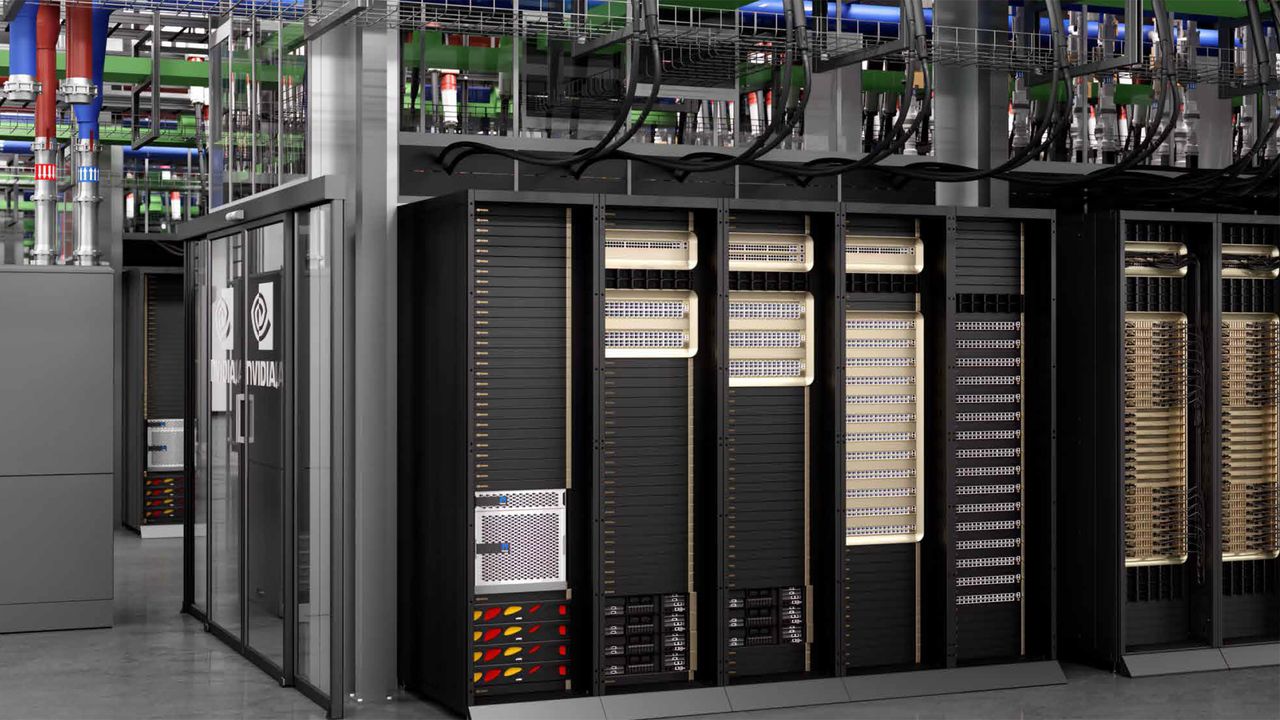
Looking ahead, Nvidia forecasts revenue of approximately $108 billion for the third quarter, plus or minus 2%, with gross margin expected around 74%. The outlook does not include any data center compute revenue from China due to export and import license uncertainties. Nvidia's CFO Colette Kress said the company expects its new Vera Rubin platform to account for about 20% of data center revenue in the third quarter, which would total roughly $20 billion in a single quarter — making it, according to Kress, the fastest product ramp in Nvidia's history. She noted the company has already received purchase orders from every major hyperscaler, AI cloud, and system OEM. Tom's Hardware calculated that if data center revenue holds near 92% of total revenue as in recent quarters, Vera Rubin sales alone could reach nearly $19.9 billion, translating to an estimated few thousand VR200 NVL72 rack-scale systems and hundreds of thousands of Vera CPUs and Rubin GPUs, based on rough per-unit pricing.
To support this scale of demand, Nvidia sharply increased its long-term purchase commitments, from $119 billion in the first quarter of fiscal 2027 to $279 billion in the second quarter, with the company saying the bulk is primarily related to memory procurement, including a supply arrangement with SK hynix. Huang said customer forecasts point to demand roughly doubling next year, but that Nvidia's supply chain can currently support about 70% growth, adding that unconstrained demand would be 'a lot, a lot higher.' Management indicated supply will remain a bottleneck at least through fiscal 2028.
Nvidia also disclosed new financial guarantees tied to AI infrastructure buildouts. The company has entered land, power and shell guarantees for AI cloud partners totaling up to $108.5 billion in maximum gross exposure. Of that, $3.5 billion covers potential default on data center lease obligations for select AI cloud partners, while the remainder is tied to credit support for roughly 4.25 gigawatts of capacity at SB Energy's PORTS-Pike Technology Campus in Ohio, which will host Nvidia chips under a 20-year lease with OpenAI. These obligations become effective once certain conditions are met, including data centers being ready starting in fiscal 2029. Nvidia said it could also provide phased credit support for an additional 3.8 gigawatts of capacity if the site scales up, though it did not disclose a dollar figure for that expansion.
Nvidia framed the arrangement as a path to future revenue, stating that each generation of its infrastructure deployed at the Ohio site could represent approximately 1.5 million GPUs, or $150 billion to $200 billion in Nvidia revenue, with the potential for multiple upgrade cycles over 20 years. The company explained that AI clouds and model makers are seeing demand that is outpacing what their balance sheets and credit profiles can support, prompting Nvidia to help select customers secure buildout sites where durable, multi-generational demand is visible. Wccftech noted these financing arrangements have drawn criticism from some observers as circular financing designed to prop up demand for Nvidia's own products, a characterization the company disputes, saying the support is necessary to scale AI infrastructure.
Alongside its results, Nvidia also announced strategic partnerships with financial firms including Apollo, BlackRock, Blackstone, Brookfield, Goldman Sachs and KKR aimed at mobilizing more than $500 billion in third-party capital for AI infrastructure buildout over time, subject to definitive agreements. The company returned approximately $26.0 billion to shareholders during the quarter through share repurchases and dividends, and had about $99.0 billion remaining under its buyback authorization as of quarter-end. Nvidia also confirmed that its Vera Rubin platform is now in full production, with racks already running at partners including CoreWeave, Google Cloud, Microsoft Azure, Oracle Cloud Infrastructure and Nebius, following first revenue shipments in August.