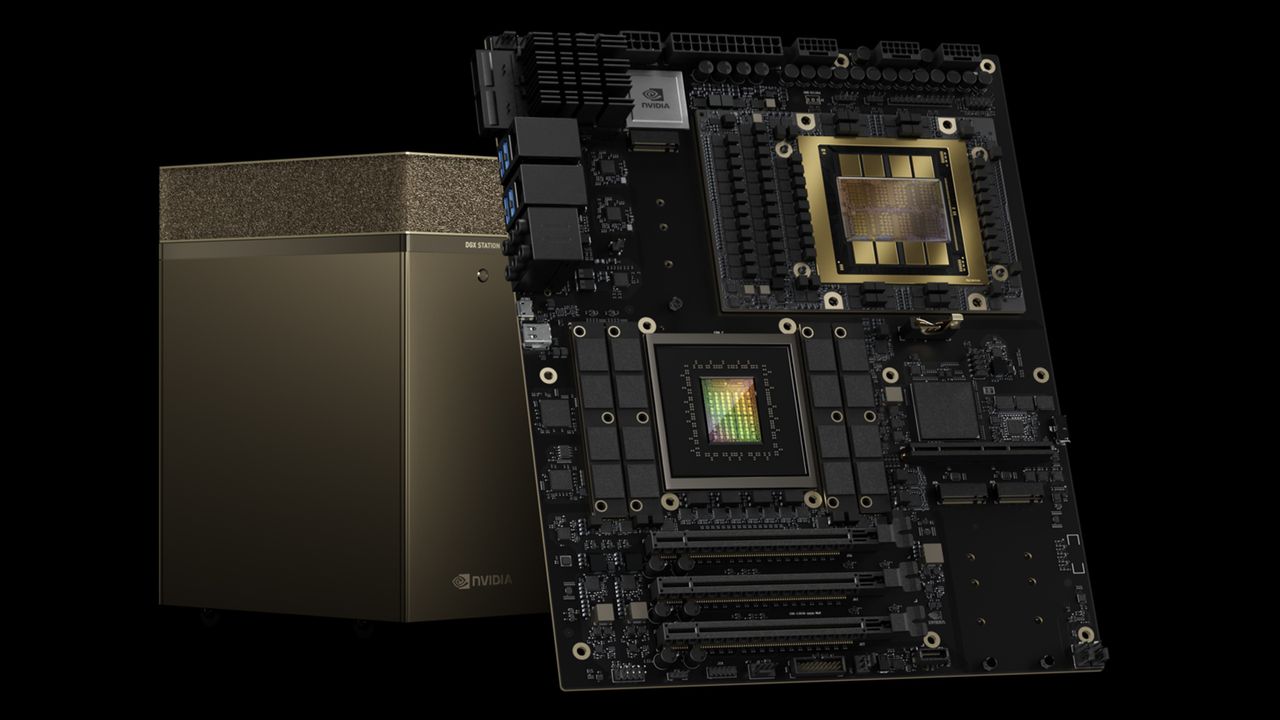
Nvidia's DGX Station desktop tower, powered by the GB300 Superchip, has been listed online for $94,930 by reseller Exxact, confirming earlier speculation that the machine would carry a roughly $100,000 price tag. Nvidia unveiled the DGX Station at Computex 2026 without publishing an official price, and company representatives reportedly declined to give a figure when asked. The Exxact listing is based on the Valence VWS-158270643 model, a design also shared by other OEMs including Dell and HP.
The base configuration includes one GB300 Superchip featuring a Blackwell Ultra GPU with 252GB of HBM3e memory, paired with a 72-core Arm-based Grace CPU via a 900 GB/s NVLink-C2C interconnect. Combined with 496GB of LPDDR5x RAM, the system offers a unified memory pool of 748GB, intended for enterprises that want to fine-tune and deploy AI models locally rather than relying on cloud services. Exxact offers several "optimized configs" up to $96,316, with a fully loaded manual configuration — including an RTX Pro 6000 Blackwell GPU and additional storage — reaching $108,350.
The tower ships with a 1,600W 80+ Titanium power supply, runs Linux-based DGX OS, and uses liquid cooling for both the CPU and GPU. Connectivity includes dual QSFP112 ports for 800 Gbps interconnects between DGX Stations, a 10 Gbps and a 1 Gbps RJ45 port, USB ports, and a headphone jack, though it lacks front-panel I/O. Buyers receive a three-year warranty and can order up to ten units, though purchases require direct contact rather than a standard checkout process.
Separately, Nvidia is pursuing a very different approach to expanding access to its Blackwell hardware through a partnership with smart electrical panel company SPAN and homebuilder PulteGroup. Under a program called XFRA, first detailed in April and expanded upon in recent reporting, Nvidia and SPAN plan to install wall-mounted compute boxes — described as air conditioner-sized — on the exterior of select new homes. Each unit reportedly contains 16 Blackwell GPUs and 4 server CPUs, with hardware valued at more than $250,000.
Homeowners selected for the pilot would pay $0 upfront, and Nvidia and SPAN would subsidize power and internet costs. In exchange, participating homeowners would receive an as-yet-undisclosed share of revenue generated by the distributed computing hardware. The pilot is currently limited to around 100 homes in select communities, with the units potentially designed to run during off-peak hours or to make use of surplus solar energy during the day.
The two initiatives illustrate different strategies within Nvidia's broader push to expand deployment of its Blackwell architecture — one aimed at enterprise buyers willing to pay six figures for a dedicated AI workstation, and the other testing whether ordinary homes could host distributed data-center compute at no direct cost to residents.