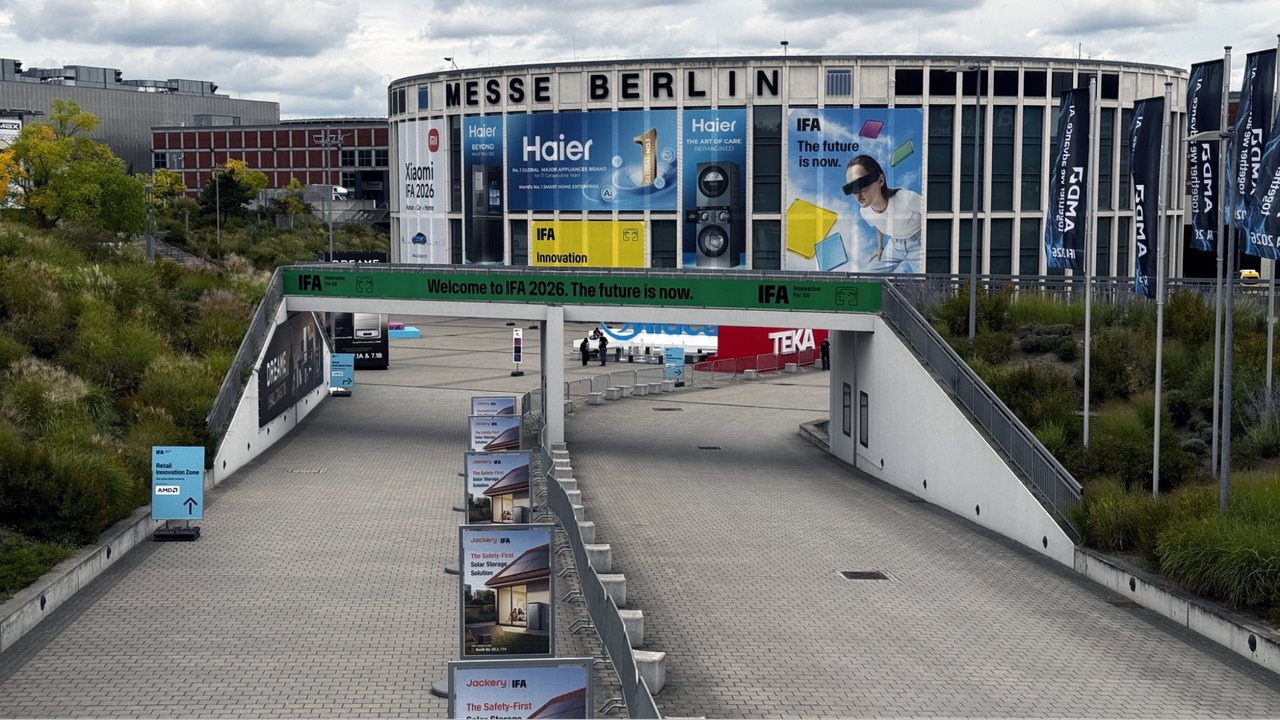
IFA isn't usually seen as a PC-focused show, but this year computing hardware was everywhere on the Berlin show floor, according to Tom's Hardware, Tom's Guide, and PCWorld. Coverage from all three outlets points to laptop makers racing to answer Apple's MacBook Neo with more affordable, colorful machines, while Nvidia and AMD pushed to bring AI computing into homes despite ongoing RAM shortages and high prices.
Lenovo's IdeaPad Vibe drew attention across outlets for offering seven colorways (developed with the Pantone Institute, per Tom's Guide) and swappable keycaps, with configurations available in AMD Ryzen AI 4000 series or Snapdragon X chips and Intel options expected later. Tom's Hardware and Tom's Guide both cite an expected $699 starting price, matching rivals like the MacBook Neo and Dell's XPS 13. Dell also showed off the Dell 14S, an all-aluminum, college-oriented MacBook Neo competitor with display options ranging from 2K to 2.8K OLED; Tom's Guide reported Dell described pricing as "complementary" to the XPS 13, with one writer predicting a $699 price point, though this was not officially confirmed.
On the ultralight side, Acer's Swift Blade 14 impressed multiple outlets for its light weight — reported as 799 grams by Tom's Guide and 1.76 pounds by PCWorld — paired with an OLED display and Intel Core Series 3 chips. Lenovo's Project AeroBlade concept, covered by both Tom's Guide and PCWorld, uses Frore's fanless AirJet cooling modules to cool an Intel chip (described as Lunar Lake by Tom's Guide and Core Ultra 200 by PCWorld) in a magnesium-aluminum shell under 10mm thick and about 1.83 pounds; PCWorld noted Lenovo concepts have previously made it to market, suggesting a possible 2027 release.
Home AI computing was a major theme. Nvidia continued teasing its RTX Spark platform, with PCWorld reporting an October launch for the RTX Spark N1X in two variants — one with GPU performance comparable to an RTX 5070, the other closer to a 5060 Ti — alongside Grace CPU options, up to 128GB of unified memory, and up to 1 petaflop of AI compute in devices like Acer's SFF RTX Spark Mini Workstation. Nvidia also introduced RTX PAIR, free software that pools GPUs across a user's own PCs to speed up local AI inference; PCWorld reported an example task dropping from over 18 minutes to 9 minutes when split across three machines. AMD, meanwhile, saw its Ryzen AI Max+ Pro 495 chip (with up to 192GB of unified memory) appear in device partners' hardware, including Minisforum's MS-S1 Max-P495 workstation and, notably, the Minisforum N5 Max — a five-bay NAS with up to 200TB of storage that Tom's Hardware reported could run local AI models like Qwen 3.8 directly against stored files, with a possible price over $7,000.
Concept and prototype hardware generated buzz without confirmed release plans. Acer's Project DualPlay Mini, a handheld that transforms into a netbook-style clamshell with a keyboard, was described by all three outlets as impractical but impressive in person, built around a Panther Lake or related Intel chip. Lenovo's Project Swan concept expands a 14-inch laptop screen to 17 inches at the push of a button, drawing enthusiastic reactions from PCWorld and Tom's Guide, though it remains a concept for now.
Monitors also stood out. Acer's Nitro XV275U Z2 offers tri-mode resolution/refresh switching (1440p at 275Hz, 1080p at 360Hz, 720p at 500Hz per Tom's Hardware, or 520Hz per PCWorld) with 1,152-zone Mini LED backlighting and 1,000-nit HDR brightness, priced at $329 for a Q4 2026 launch. PCWorld also highlighted Alienware's 560Hz QD-OLED esports monitor and its AW3226Q 4K OLED display using new "RGB Stripe" technology for improved text clarity, priced at $699. Elsewhere, Acer's Vero 16 emphasized repairability with tool-free access, replaceable hinges and battery, and support promised for two more generations of Intel chips, while Lexar showed a credit-card-sized 512GB/1TB portable SSD called the Muse that attaches magnetically to phones via pogo pins rather than USB-C.