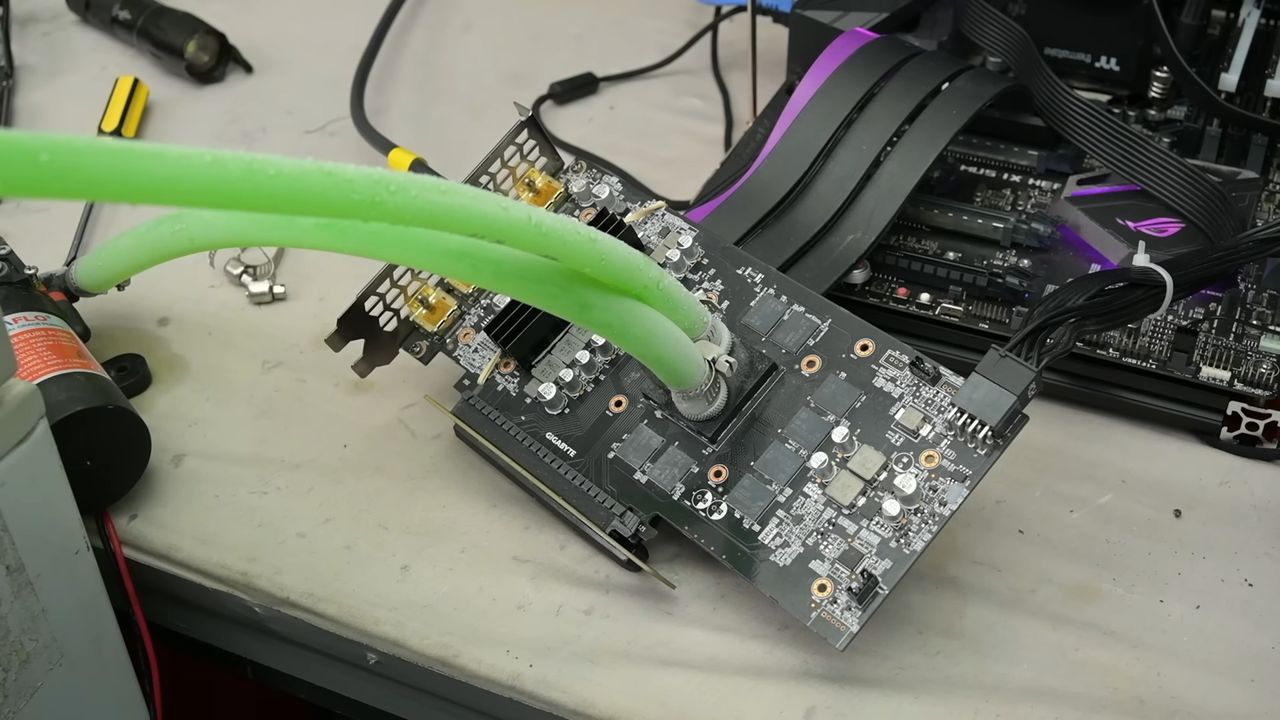
A hardware experimenter known as TrashBench has been testing a method of cooling graphics cards by removing the metal waterblock altogether and pumping water directly over the bare GPU die. The idea, as described in the project, was to question why a metal block was needed at all when coolant could instead be routed straight onto the silicon.
To manage the risk of leaks damaging expensive components, the project began with a non-working GeForce RTX 3060. A 3D-printed water block was designed to direct coolant over the die, with surrounding surface-mount components protected using nail polish. Plumbing elements such as washers, gaskets, and hose clamps were used, along with pipe fittings melted into the printed block, secured with an existing cooler's retaining mechanism.
Early tests leaked, prompting the use of epoxy adhesive to seal the block to the GPU and later to the tube fittings, which eventually produced a non-leaking setup. Sources note that not all 3D-print materials worked equally well, as some leaked or were slightly porous. After successful live tests on a powered GTX 980, the method was applied to a GeForce RTX 2060 (referred to as an RTX 2060 Super by one source), with a PCIe riser cable used as a precaution against leaks reaching the motherboard.
With the stock cooler, the RTX 2060 ran at 70°C under the Unigine Heaven benchmark. A 360mm AIO cooler brought that down to 36°C. The direct-water method reduced the temperature further to 28°C, with one source noting a hotspot reading of 41°C. Additional tests reportedly used coolant chilled to -28°C.
The same direct-water approach was also tried on an Intel Core i5-7600K CPU, chosen because it was considered expendable. According to the sources, this CPU test did not perform as well as the AIO cooler, with the outcome attributed to the size of the cooling chamber.
Both sources describe the project as a novel but risky experiment rather than a practical recommendation, noting that the method requires significant expertise and carries a real risk of permanently damaging hardware.