AMD's EXPO ULL (Ultra Low Latency) is an enhanced memory profile that optimizes DDR5 sub-timings at the factory to reduce latency without raising clock speeds, benefiting workloads like gaming and memory-intensive applications. However, EXPO ULL kits carry a noticeable price premium over standard EXPO memory.
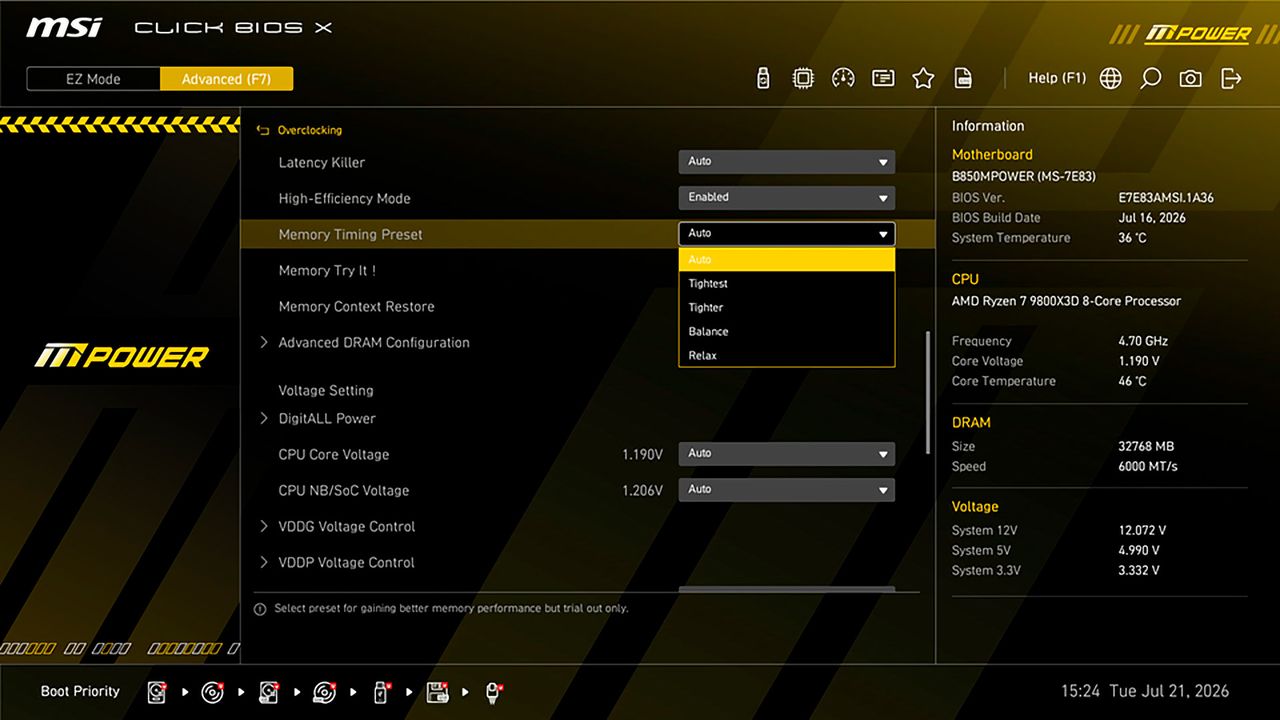
In response, MSI has rolled out a new feature called High-Efficiency Mode for its AM5 motherboards, available through the CLICK BIOS X interface under the Overclocking tab after installing the latest BIOS. The feature performs its own sub-timing optimizations on standard EXPO memory kits, aiming to approximate the latency benefits of factory-tuned EXPO ULL kits without requiring the purchase of one.
High-Efficiency Mode offers four presets—Tightest, Tighter, Balance, and Relax—representing different levels of tuning aggressiveness. Because results can vary based on hardware and memory silicon quality, MSI encourages users to test different presets rather than expecting a single ideal setting for every system.
To demonstrate the feature, MSI tested a standard G.Skill Trident Z5 Neo DDR5-6000 C30 kit against its EXPO ULL counterpart, the Trident Z5 NeoX RGB DDR5-6000 C32, on an MSI B850MPOWER motherboard with a Ryzen 7 9800X3D processor. With High-Efficiency Mode disabled, the standard kit measured 79.4 ns of latency compared to 71.4 ns for the EXPO ULL kit. With High-Efficiency Mode enabled on the standard kit, latency dropped to 71.6 ns, closely matching the ULL kit's performance—a reduction described as about a 9.8% improvement on the tightest setting. Enabling the feature on the EXPO ULL kit itself produced little additional benefit, since those kits are already factory-optimized.
Because High-Efficiency Mode relies on automated tuning rather than manual configuration, it could introduce system instability similar to manual overclocking, and outcomes may differ across individual systems. Whether users notice real-world benefits also depends on their workload: latency-sensitive tasks such as large databases or code compiling may see more improvement, while bandwidth-heavy tasks like video editing or 3D rendering are less affected. Pricing context adds relevance to the feature—the standard Trident Z5 Neo kit that once sold for $119.99 now costs more than five times that amount amid ongoing memory shortages, and the EXPO ULL version carries an additional 4.1% premium over that already inflated price.