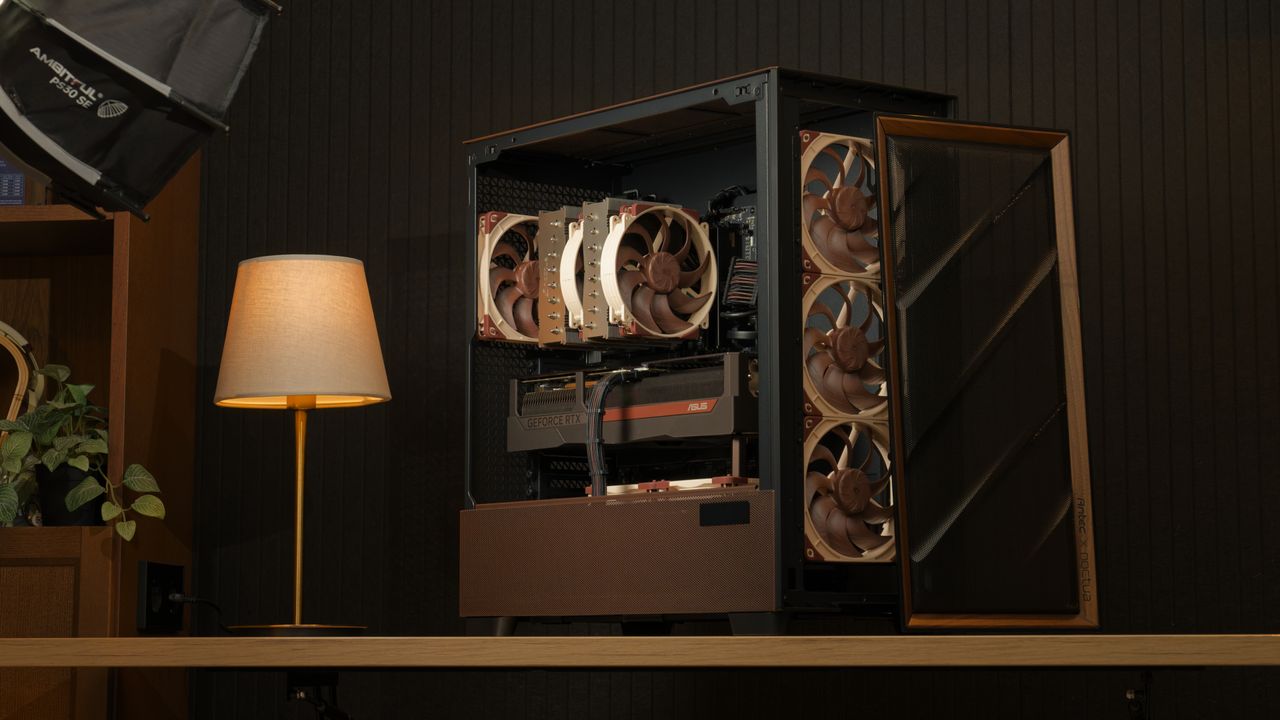
Noctua, known for its air coolers, fans, and more recently AIOs, has published its own measurements of PC case CPU cooler clearances after PC builders noted discrepancies with official specifications. According to the company, it manually measured more than 100 cases and found that 56 of them showed significant deviation from what is listed on manufacturers' websites.
In many cases, the actual clearance was larger than advertised, meaning builders could have fit a bigger, better-performing cooler than the spec sheet suggested. Examples cited include the NZXT H2 Flow, listed at a 75mm maximum cooler height but actually able to fit up to 79mm, and the Thermaltake TR100, which offers 2.7mm more clearance than stated. Both outlets highlight Corsair cases as offering notably more room than advertised: Tom's Hardware cites the Corsair Frame 4000D with 10mm of extra clearance, while Wccftech reports that Corsair's 4000D and 5000D series offer close to 10mm of additional clearance, enough to accommodate a 168mm-tall cooler like Noctua's NH-D15 G2 with room to spare.
Noctua also found cases where the real clearance was smaller than advertised, which it flagged as a more serious concern since it could mean a cooler doesn't fit at all or touches the case panels. Tom's Hardware reports the Asus Prime AP201 is 1.7mm shorter than listed and the Lian Li B4-mATX is 3.5mm shorter than its spec page states. Wccftech also names the Asus Prime AP201 as an example of reduced clearance, though it puts the difference at roughly 2mm lower than advertised, a figure that does not exactly match Tom's Hardware's number.
Both outlets frame this as a reason for builders to be cautious about relying solely on manufacturer specifications, particularly for compact cases such as mini-ITX builds where tolerances are tight. Tom's Hardware suggests buying the case first and measuring it directly, or using Noctua's compatibility search tool, which lists clearances verified by the company's own team. Wccftech notes that Noctua's database, built from manually measuring the cases, organizes results into tables showing which coolers fit which cases, and that the company plans to keep expanding it with more models over time.
Tom's Hardware raises an additional question the sources leave unanswered: whether similar inaccuracies might exist in manufacturers' listed clearances for other components like GPUs and power supplies, since Noctua's database only covers CPU cooler compatibility. Wccftech notes that while the database technically shows compatibility for Noctua's own coolers, it can also serve as a general guide for judging whether non-Noctua coolers would fit a given case.