Nvidia's DLSS 5 has arrived as an official feature in NBA 2K27, though it isn't labeled as 'DLSS 5' in the game's settings menu. Instead, players see a simple on/off toggle called 'DLSS Neural Rendering.' According to PC Gamer, this naming shift — first spotted in leaked DLL files that referred to the tech as 'Nvidia DLSSNR' — may be an attempt by Nvidia to separate the new AI image-generation feature from the well-established DLSS upscaling brand, after confusion and backlash over lumping the two together under one name.
Hands-on impressions from GamesRadar+, tested on an RTX 5080, found that DLSS 5 can meaningfully improve photorealism in NBA 2K27 — enhancing court surfaces, background environments, and crowd NPCs — without being as exaggerated as Nvidia's earlier marketing stills suggested. However, the outlet found a notable flaw during cutscenes and dialogue, where hyper-realistic faces don't sync properly with lip animation, creating an uncanny mismatch. GamesRadar+ also questioned whether the added detail was necessary at all, since the game already looks strong without it.
Performance is the bigger sticking point. With Nvidia's multi-frame generation enabled, GamesRadar+ saw smooth results (roughly 222–238 fps) in a test match, but disabling frame generation caused frame rates to crash to 49–55 fps, compared to 150–165 fps with DLSS 5 off entirely. Separately, PC Gamer reported an up to 73% performance hit on an RTX 5080 in early NBA 2K27 testing, aligning with Nvidia's own stated 50–60% performance cost for the feature.
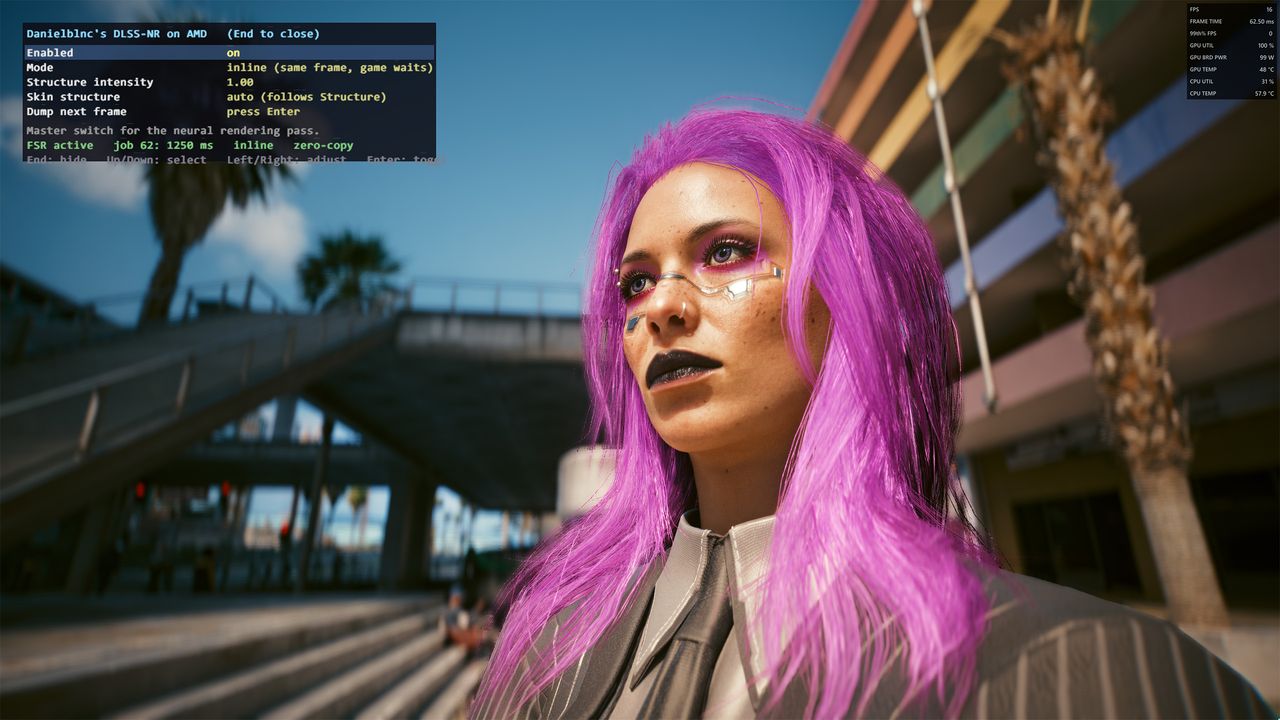
Modders have moved quickly to extend DLSS 5's reach beyond its one official use case. After DLL files were pulled from an early access build of NBA 2K27, community tools emerged that let players force the tech — now often called DLSS Neural Rendering — into other games such as Cyberpunk 2077 and Football Manager 26, even on hardware Nvidia never designed it for. A new GitHub tool from user danielblnc reportedly enables DLSS Neural Rendering on AMD Radeon GPUs for the first time.
PC Gamer tested this AMD version on an RX 9070 XT in Cyberpunk 2077. Getting it running required troubleshooting a Windows Defender false-positive virus flag, fixing a black-screen bug, and rolling back AMD Adrenalin drivers. Once functional, performance cratered: running at 4K with ray tracing on Ultra and FSR 4 set to Balanced, frame rates dropped from 61 fps to just 9 fps with DLSS Neural Rendering enabled — an roughly 85% hit, worse than the drop seen on Nvidia hardware. PC Gamer attributes this to RDNA 4's comparatively weak dedicated matrix-calculation hardware, similar to the limitations seen on Nvidia's own older RTX 20-series Tensor Cores. A YouTuber referenced in the piece, Ancient Gameplays, noted a 12% performance improvement since the AMD tool's first release, though PC Gamer suggests a hardware ceiling may prevent DLSS Neural Rendering from becoming practical on this generation of AMD cards.