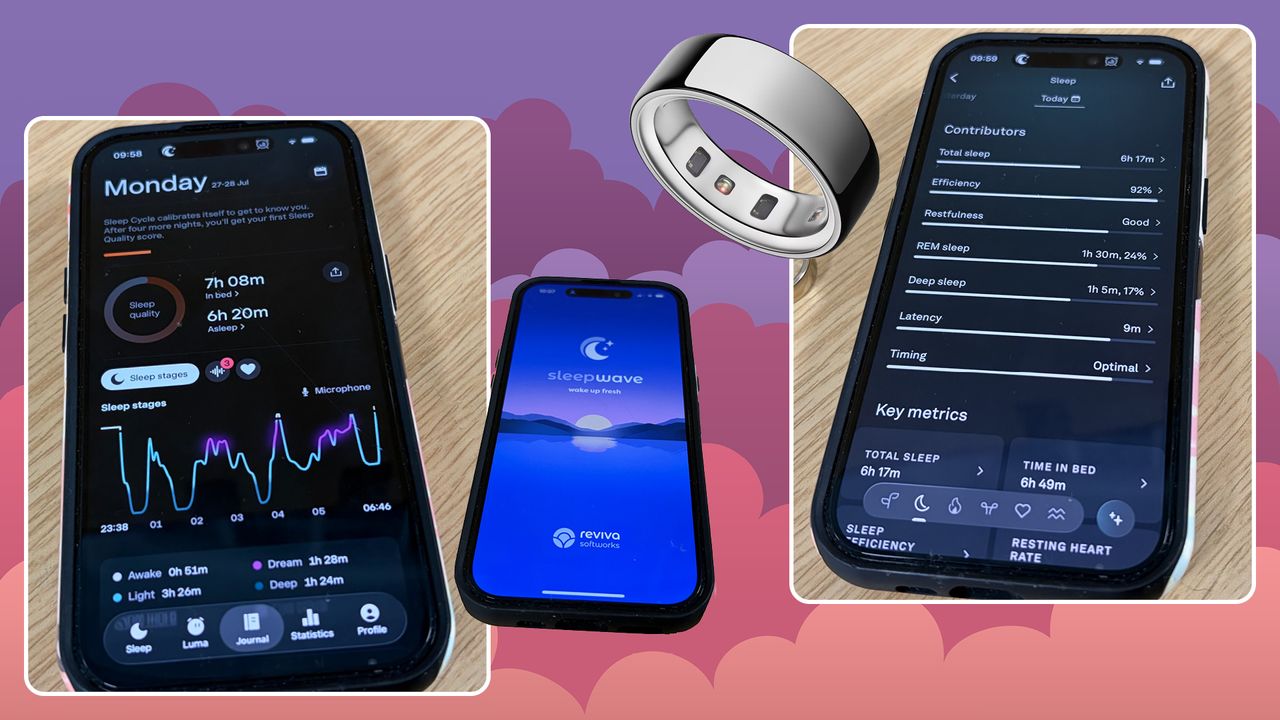
A Tom's Guide writer wearing the Oura Ring 5 (from $399 at Amazon) tested three free iPhone sleep-tracking apps — Sleep Cycle, SleepScore, and Sleepwave — over separate nights to see whether free apps could rival the accuracy of a premium wearable. The Oura Ring 5 tracks sleep using light-based, thermal, and kinesthetic sensors, measuring duration, sleep stages, sleep debt, nighttime breathing, and heart rate variation. The free apps instead rely on a phone's microphone, accelerometer, or sonar (speaker waves) to detect movement and sound.
Sleep Cycle, which uses sound detection and an accelerometer, scored 3.5 out of 5. Its sleep duration and REM data were close to Oura's readings, but its deep sleep, core sleep, and latency figures showed gaps of 16 to 21 minutes. SleepScore, which uses sonar technology and also provides a nightly sleep score, scored 3 out of 5; its light and deep sleep data closely matched Oura's, but sleep duration and REM sleep were off by 36 and 46 minutes respectively, though its overall sleep score (70) nearly matched Oura's (71).
Sleepwave, which uses patented motion-sensing technology, scored a full 5 out of 5. Four of its five metrics — sleep duration, latency, deep sleep, and core sleep — fell within a 5-minute accuracy threshold compared to Oura, with only REM sleep off by 8 minutes. The tester called the results "impeccable" for a free app, noting it was easy to set up, though it lacks an overall sleep score feature.
Separately, Tom's Guide reports that the broader sleep tech industry is shifting away from passive tracking toward devices that actively intervene to improve sleep. Companies such as Elemind, NextSense, and Muse are developing tools that monitor brainwaves in real time and respond to disruptions, rather than simply reporting data after the fact. Elemind co-founder Meredith Perry described this as a "read and write" approach, while NextSense CEO Jonathan Berent called it a continuous, closed-loop conversation between the brain and the technology.
Other devices mentioned include the Kimba scent system, Sleepal lamp, Orion sleep system, and Eight Sleep, which adjust environmental factors like scent or temperature in response to tracking data. Some founders, including Elemind's Perry, predict that purely passive tracking devices will become obsolete within a decade, giving way to tools that actively guide sleep. The report notes that despite these advances, cognitive behavioral therapy for insomnia remains the gold standard for treatment, and medical conditions such as sleep apnea still require professional care.
Both pieces point to a common theme: consumer sleep technology is evolving quickly, whether through more accurate free tracking options or through a new generation of devices aiming to actively fix sleep problems rather than just document them.