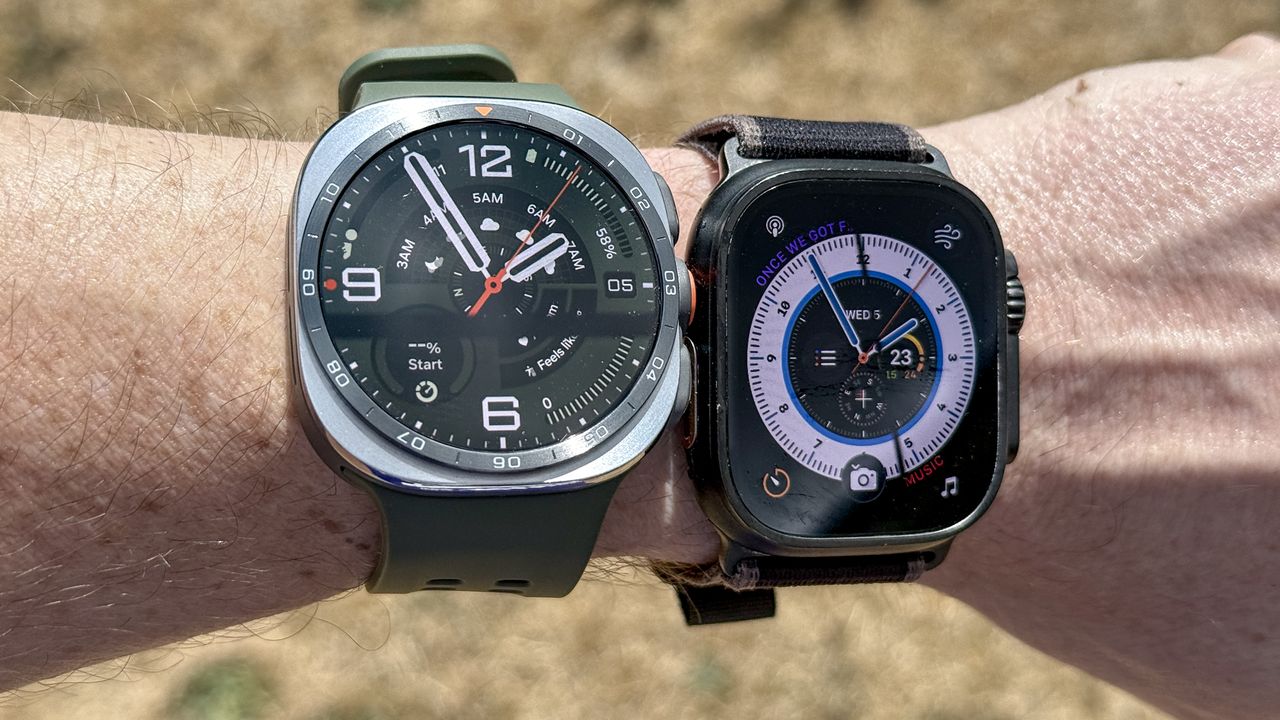
Tom's Guide ran two separate side-by-side tests of the Samsung Galaxy Watch Ultra 2 against competing smartwatches. In one test, editor Jeff Parsons wore the Galaxy Watch Ultra 2 on one wrist and his Apple Watch Ultra 2 on the other during a 10K run. In a separate test, editor Dan Bracaglia wore the Galaxy Watch Ultra 2 alongside a Garmin Instinct 3 during several hours of e-mountain biking in Washington State's Cascade range.
During the 10K run, the two watches recorded similar but not identical data: the Galaxy Watch Ultra 2 logged a duration of 50:14 versus 52:54 on the Apple Watch Ultra 2, with distances of 10.05 km and 10.15 km respectively. Both watches recorded the same average heart rate of 135 bpm. Parsons attributed some of the differences to auto-pause being enabled on the Samsung watch during push-up breaks, which caused it to stop and start recording, while the Apple Watch kept running continuously.
Parsons highlighted three areas where the Galaxy Watch Ultra 2 impressed him: its 1.52-inch Super AMOLED display, which reaches up to 5,000 nits compared to 3,000 nits on the Apple Watch Ultra 2 and remained legible in changing light; stronger haptic feedback, which he felt more distinctly than the Apple Watch's Taptic Engine; and the bundled Marine Band strap, which stayed dry and comfortable compared to the sweat-soaked Trail Loop band on the Apple Watch. However, he preferred the Apple Watch Ultra 2's Digital Crown over Samsung's Touch Bezel feature, saying the physical crown was easier to use with running gloves. Overall, Parsons judged the Galaxy Watch Ultra 2 the stronger performer for that run, citing its brightness, storage and battery life, and lower launch price of $699 versus $799 for the Apple Watch Ultra 2, though he still had reservations about its case design.
In the e-mountain biking test, Bracaglia found the Galaxy Watch Ultra 2 lacked a dedicated e-bike or mountain e-bike mode, forcing him to use its standard mountain bike tracking mode, while the Garmin Instinct 3 had a mode built specifically for the activity. Using the Strava app as a reference point, the Garmin overcounted elevation gain by 141 feet, while the Galaxy Watch Ultra 2 overcounted by 344 feet; the Samsung watch also failed to display total ascent in its post-workout summary, requiring Bracaglia to record the figure manually during the ride.
Bracaglia also found the Garmin Instinct 3 more comfortable over several hours of riding, noting it is smaller and significantly lighter at 54 grams compared to 86 grams for the Galaxy Watch Ultra 2. Despite this, he said the Galaxy Watch Ultra 2's display was easier to read in direct sunlight than the Garmin's, crediting its 5,000-nit peak brightness. For this activity, he concluded the Garmin Instinct 3 was the clear choice.
Taken together, the two tests suggest the Galaxy Watch Ultra 2's screen brightness was a consistent strength across both comparisons, while its performance relative to rivals varied depending on the activity: it came out ahead of the Apple Watch Ultra 2 in the running test but behind the Garmin Instinct 3 for e-mountain biking, particularly due to missing activity modes and less accurate elevation tracking.