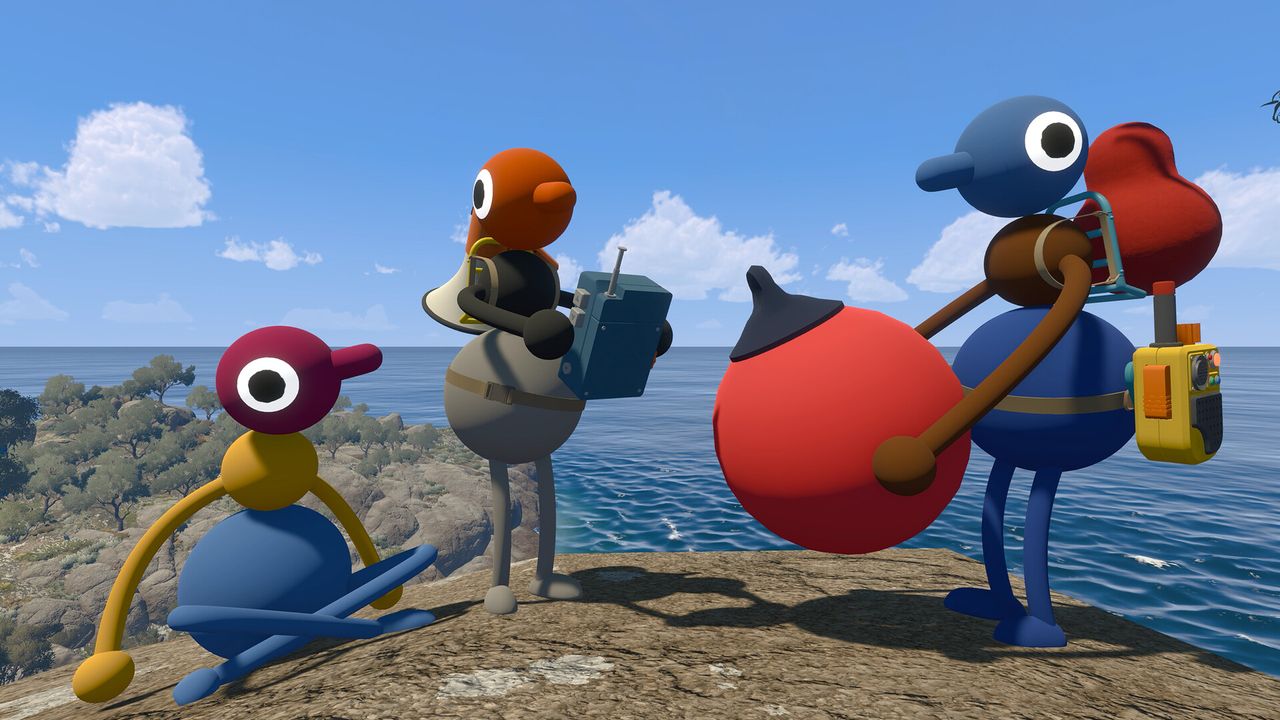
Big Walk, a new open-world adventure from Untitled Goose Game developer House House and publisher Panic, launched to a strong start, peaking at nearly 50,000 concurrent players on Steam and earning a 'Very Positive' rating. The game is built entirely around cooperative play — puzzles require collaboration, and it's effectively pointless to explore alone, since all the challenges are designed for multiple players working together.
Because Big Walk has no matchmaking, players need to either host a session or join one via a code shared by a friend, which is the only method available on PS5 and Nintendo Switch 2. On PC, players can also join sessions through their Steam friends list without needing a code. Those without friends interested in playing have been directed to community spaces like the Big Walk subreddit or PC Gamer forums to find others to team up with.
The game's puzzles are scattered around its world and often demand creative communication. Examples include a puzzle requiring one player to relay a five-symbol code to a partner on the other side of a locked door, a switch puzzle where players spread too far apart for voice chat must coordinate a visual signal to act simultaneously, and a stacking puzzle where players climb atop one another to reach a button. Other puzzles rely on players finding coordinates on a map and communicating them to teammates, sometimes using in-game walkie-talkies.
Since proximity voice chat has a short range and falls off quickly with distance, Big Walk also gives players non-verbal tools to communicate, including simple arm gestures, a whiteboard for writing messages, and flashlights or laser pointers for signaling. These tools become essential in puzzles where players are separated beyond chat range or placed behind soundproof barriers, allowing entire challenges to be solved without speaking a word.
Despite the positive reception, many negative Steam reviews cite the same issue: the single audio volume slider makes it difficult to hear friends' voices over ambient sounds like ocean waves, with some players describing voices as barely audible even at max volume. House House has acknowledged the problem, saying in a Steam post that while the game is designed to have voices grow quieter with distance, some players' voices are quieter than intended even at close range, and that a fix is in development. In the meantime, a fan-made mod that adds a separate voice volume slider has appeared on GitHub.
Reviewers have also praised other aspects of the game, including its in-game tutorial, which teaches controls through open-ended play in a toy-filled room rather than explicit instructions, and its charming character design of simple, ant-like figures with noodly arms used for expressive gestures.