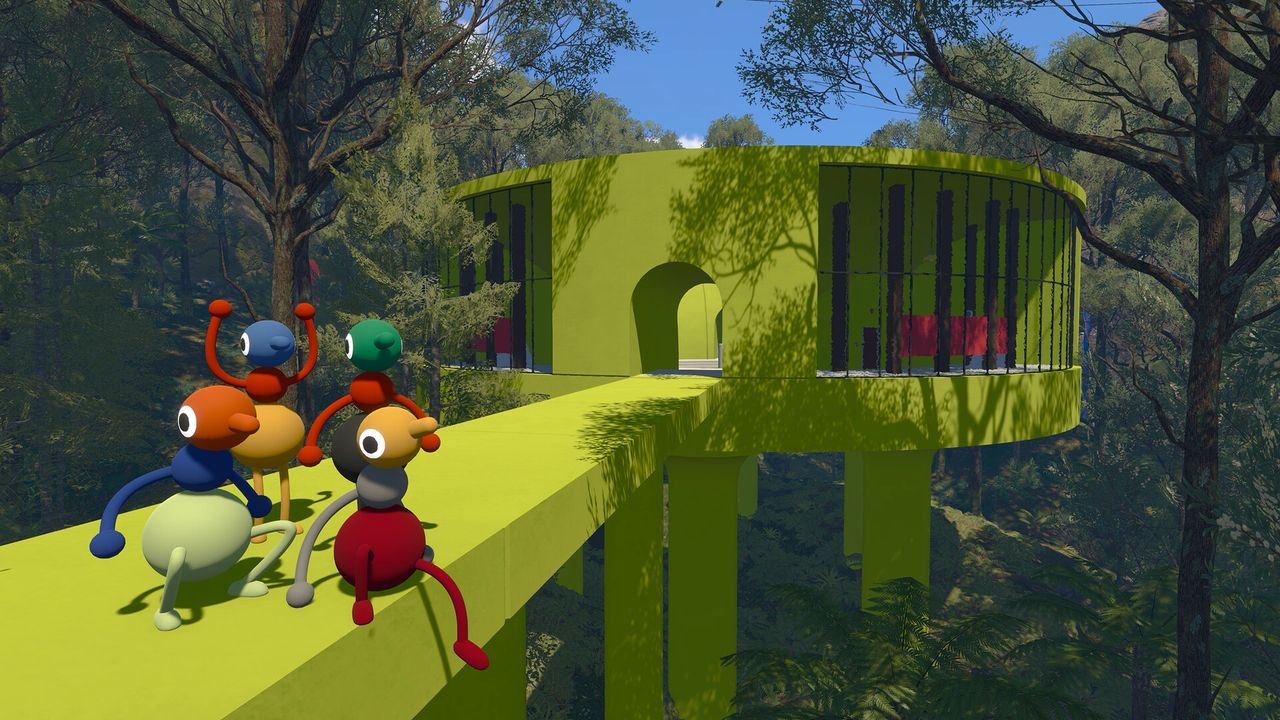
Big Walk, the new game from Melbourne studio House House (Untitled Goose Game), launches August 4 on PlayStation 5, PC via Steam, and Nintendo Switch 2. According to GamesRadar+, the game releases first on PS5 in the UK/EU and Australia/New Zealand PlayStation Stores, followed roughly five hours later by a simultaneous release on PS5 in the US and worldwide on PC via Steam. No official Switch 2 release time has been announced, though GamesRadar+ suggests it will likely mirror the Steam timing based on past third-party launches. The outlet also notes there is no known workaround, similar to the 'New Zealand trick' used on Xbox, for PS5 players to access the game early.
Reviewers across Kotaku, Polygon, PC Gamer, and Eurogamer describe Big Walk as a cooperative game set on an uninhabited, wilderness-like island dotted with brightly colored, playground-style structures. Players explore the island, solve puzzles that require teamwork, and collect a red, gourd-like reward item that unlocks new areas and abilities. None of the reviewers agreed on an official name for this item — Kotaku called it a 'nipple,' Polygon a 'baby,' PC Gamer a 'nubbin,' and Eurogamer a 'kong' — but all agreed it is central to progression.
A key mechanic across all four reviews is the game's proximity-based voice chat, which has an intentionally short range, forcing players to stay close, use gestures, or rely on items like walkie-talkies, flashlights, flare guns, laser pointers, and megaphones to communicate. Players can only carry one item at a time, and items can be dropped or lost if a player falls or is separated from the group. Both Kotaku and PC Gamer specifically advise against using Discord instead of in-game proximity chat, saying it removes much of the challenge and impact of the experience; PC Gamer notes that the game itself warns players against this on first launch and includes noise cancelling and a mute button to support voice chat.
All four outlets highlight the game's mix of comedic, chaotic moments — such as characters getting stuck on rocks, items rolling away, or players getting lost in the dark — with more reflective or emotional beats. Reviewers describe puzzles that require creative communication, including scenarios where players are separated by soundproof glass and must devise gestures or use tools like laser pointers to convey information. Eurogamer and Kotaku both single out the game's ending as a highlight, describing it as an emotional, memorable conclusion that ties together the skills and bonds built throughout the game; Kotaku compares its structure favorably to the ending of Untitled Goose Game.
The game supports groups of two to twelve or more players, with puzzles scaling in complexity based on group size, according to Kotaku and PC Gamer. Multiple reviewers, including Eurogamer and Polygon, mention that sessions typically restart from a shared hub area, and that players can drop in and out between sessions, though Kotaku recommends against frequently swapping players since the experience builds cumulatively. Kotaku also notes the world grows genuinely dark at night, requiring light sources, a point echoed by Eurogamer, which compares the darkness to other notably dark game environments.
Critics broadly praised the game's puzzle design, sound design, and ability to foster communication and connection among players, with Kotaku and Eurogamer explicitly linking the game's themes to loneliness, connection, and the aftermath of pandemic-era isolation. The main criticism raised, shared by both Kotaku and Eurogamer, involves occasional clunkiness in movement and traversal, such as getting stuck on rocks or uneven terrain. Kotaku and Polygon both note that the game's surprises are largely a one-time experience, since puzzle solutions can't be rediscovered once known, while Kotaku mentions there is additional post-game content still being explored.