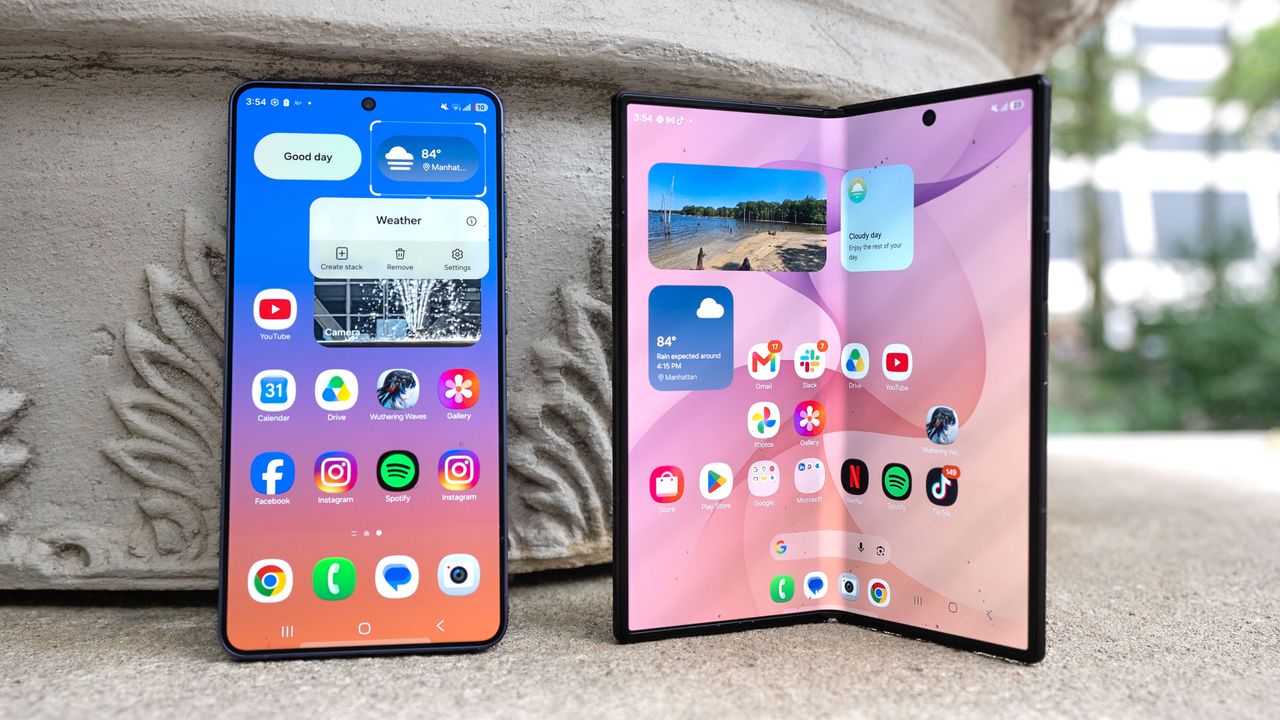
Tom's Guide tested the Samsung Galaxy Z Fold 8 Ultra against the Galaxy S26 Ultra and found a mix of upgrades and trade-offs. The Fold 8 Ultra starts at $2,099, which is $800 more than the S26 Ultra's $1,299 starting price. Both phones use the same Snapdragon 8 Elite Gen 5 chip, have 5,000 mAh batteries, and offer similar main and ultrawide camera performance, but they differ in several other areas.
On design, the Fold 8 Ultra weighs 215 grams and is 4.1mm thin when unfolded, with an 8-inch inner display and 6.5-inch cover display, versus the S26 Ultra's single 6.9-inch screen at 214 grams. The Fold 8 Ultra's screen hit 2,687 nits of HDR brightness in testing, compared to 1,806 nits on the S26 Ultra, and includes an anti-reflective coating and a less visible crease thanks to Flex Titanium technology. However, the S26 Ultra has a Privacy Display feature the Fold lacks, carries an IP68 dust and water resistance rating versus the Fold's IP48 rating, and includes a built-in S Pen, which the Fold 8 Ultra does not support. Samsung executives told Tom's Guide they are "open" to bringing the S Pen back to future Fold models.
In cameras, the Fold 8 Ultra has a single 10MP telephoto lens with 3x optical zoom and up to 30x digital zoom, while the S26 Ultra has dual telephoto lenses (5x and 3x) with up to 100x digital zoom, giving the S26 Ultra a clear advantage in zoomed shots, as seen in test photos of an ice cream truck sign and a building sculpture. The S26 Ultra also has a slight edge in low-light brightness and a 12MP selfie camera versus the Fold's dual 10MP shooters, though the Fold lets users take selfies with its sharper rear cameras via the cover screen. In benchmark testing, the S26 Ultra edged out the Fold 8 Ultra in Geekbench, 3DMark graphics, and Geekbench AI scores, and it also lasted longer in battery testing — 16 hours 40 minutes versus 14 hours 33 minutes for the Fold — though the Fold's larger 8-inch display was a factor. Both phones charge to roughly the same percentage in 30 minutes despite the S26 Ultra's faster rated wired and wireless speeds.
Looking ahead, Tom's Guide also compared the S26 Ultra to the rumored Google Pixel 11 Pro XL, expected to launch August 12 at a starting price around $1,299. Based on leaks, the Pixel 11 Pro XL may feature a 6.8-inch display reaching up to 3,600 nits of brightness, a Tensor G6 chip with a MediaTek modem, a 50MP main camera with 48MP ultrawide and telephoto lenses, and a 5,115 mAh battery — smaller than the outgoing Pixel 10 Pro XL's battery, which itself trailed the S26 Ultra in Tom's Guide's battery test (14 hours 35 minutes versus 16 hours 10 minutes). Tom's Guide noted Google typically lags Samsung in raw performance and battery life but competes through software features and faster access to Android updates, and cautioned that final judgments will depend on hands-on testing once the Pixel 11 Pro XL is released.
Separately, Tom's Guide tested the updated Samsung DeX desktop mode arriving on this year's foldable lineup — the Galaxy Z Flip 8, Z Fold 8, and Z Fold 8 Ultra. The key new feature is support for up to four separate workspaces, each holding up to five apps, allowing as many as 20 apps to be organized simultaneously across categories like work, social media, and editing tools. This workspace feature was inherited from the version of DeX introduced on the Galaxy S26 and the now-discontinued Galaxy Z TriFold. Tom's Guide said DeX still lacks features such as Windows 11-style app snapping into quadrants and support for multiple user profiles, but described being able to complete about 90% of daily work tasks using DeX alone, especially when paired with accessories like a wireless mouse, Bluetooth keyboard, or Xreal smart glasses.