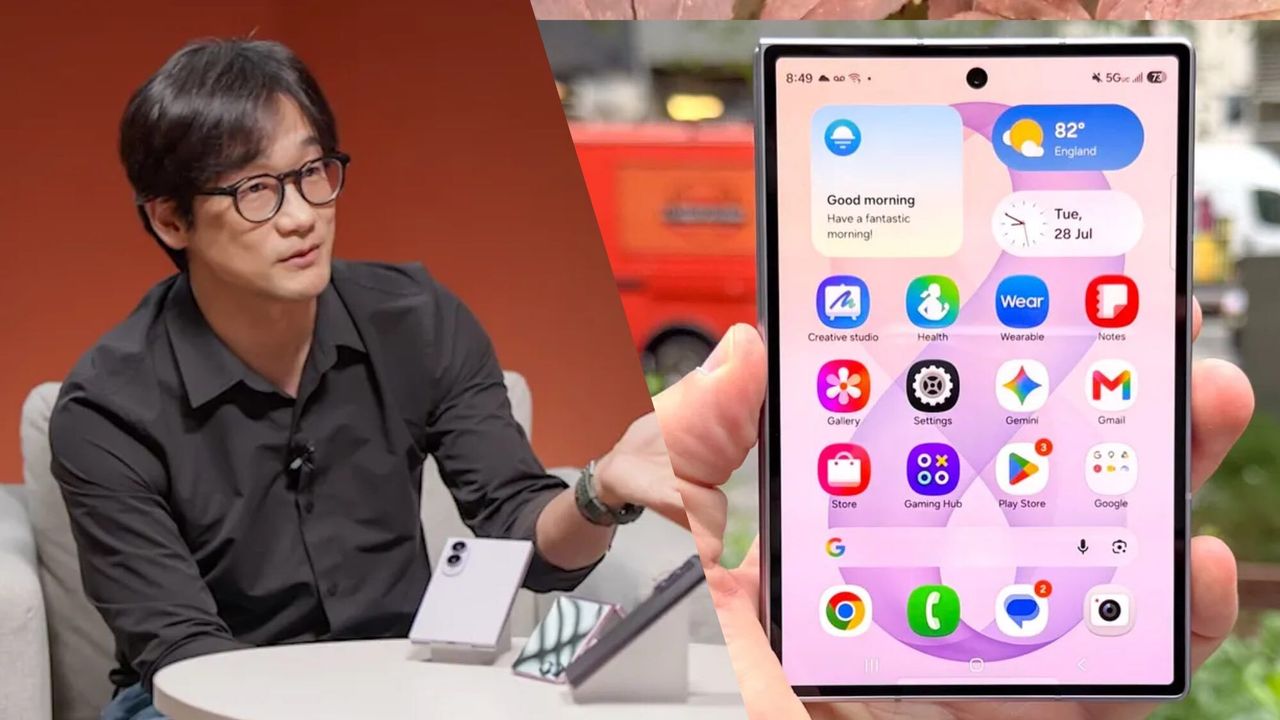
Samsung is taking a noticeably different tack with AI on the new Galaxy Z Fold 8 and Fold 8 Ultra, according to comments from Samsung EVP Jay Kim. Rather than pushing 'Galaxy AI' as a headline feature, the company says it wants AI to work quietly in the background. 'We don't want to overwhelm the consumer with AI,' Kim said, adding that the industry focus is shifting 'from technology to benefits' and toward making features 'easy to access.'
This philosophy shows up in features like Now Nudge, which detects things like an appointment mentioned in a text and offers a Calendar shortcut that opens in split-screen view, and My FanCam, which lets users select a subject in a video and have the phone automatically recut footage to follow that person, complete with adjustable aspect ratio. Samsung has also expanded Gemini Intelligence task automation to 40 apps, letting the phone handle tasks such as booking a vacation through Expedia, jumping in to complete steps but stopping short of making purchases without explicit user approval. Kim said Samsung is deliberately taking automation 'one step at a time' because 'the experience is more important' than rushing features to market.
A hands-on review of the Galaxy Z Fold 8 Ultra found substantial upgrades over its predecessor, the Z Fold 7. The phone recorded 14 hours and 33 minutes on a custom battery test, close to four hours longer than the Z Fold 7, thanks partly to a larger 5,000 mAh battery, and it charged to 76% in 30 minutes despite Samsung's official 67% claim. It also introduced Samsung's custom 'for Galaxy' chipset to a foldable for the first time, boosting benchmark scores over the Z Fold 7 across single-core, multi-core, graphics and AI tests. The display reached a measured peak of 2,687 nits with a new anti-reflective coating, making it, per the review, the brightest phone tested so far, ahead of the Google Pixel 10 Pro XL and well beyond the iPhone 17 Pro Max.
Camera performance was mostly strong, with the 200MP main lens producing sharper images than the iPhone 17 Pro Max and low-light photos benefiting from a new ProVisual imaging engine. However, the 10MP telephoto lens was described as performing poorly, especially at higher zoom levels, lagging behind the Galaxy S26 Ultra's telephoto hardware. The review also flagged persistent design complaints: the Z Fold 8 Ultra still lacks S Pen support (removed last year when Samsung cut the digitizer layer to reduce thickness) and does not support magnetic wireless charging without a case, despite Qi2 compatibility. Pricing starts at $2,099 for 256GB, rising to $2,299 and $2,699 for higher storage tiers — the third consecutive year Samsung has raised the price, with no early pre-order storage bonus offered this time.
Separately, a follow-up report on the standard Galaxy Z Fold 8 challenged early impressions that its screen was 'crease-free.' After a week of daily use, the reviewer found the crease returned, attributing this to mechanical fatigue and 'plastic deformation' in the display layers from repeated folding, heat and pocket pressure — a pattern seen on other foldables as well. The report noted the crease is mainly a visual issue, more noticeable under glare, and does not change how the screen feels to the touch; it emphasized this is not being called a dealbreaker but is meant to correct the narrative that the display is permanently crease-free, since Samsung itself never used that specific claim.