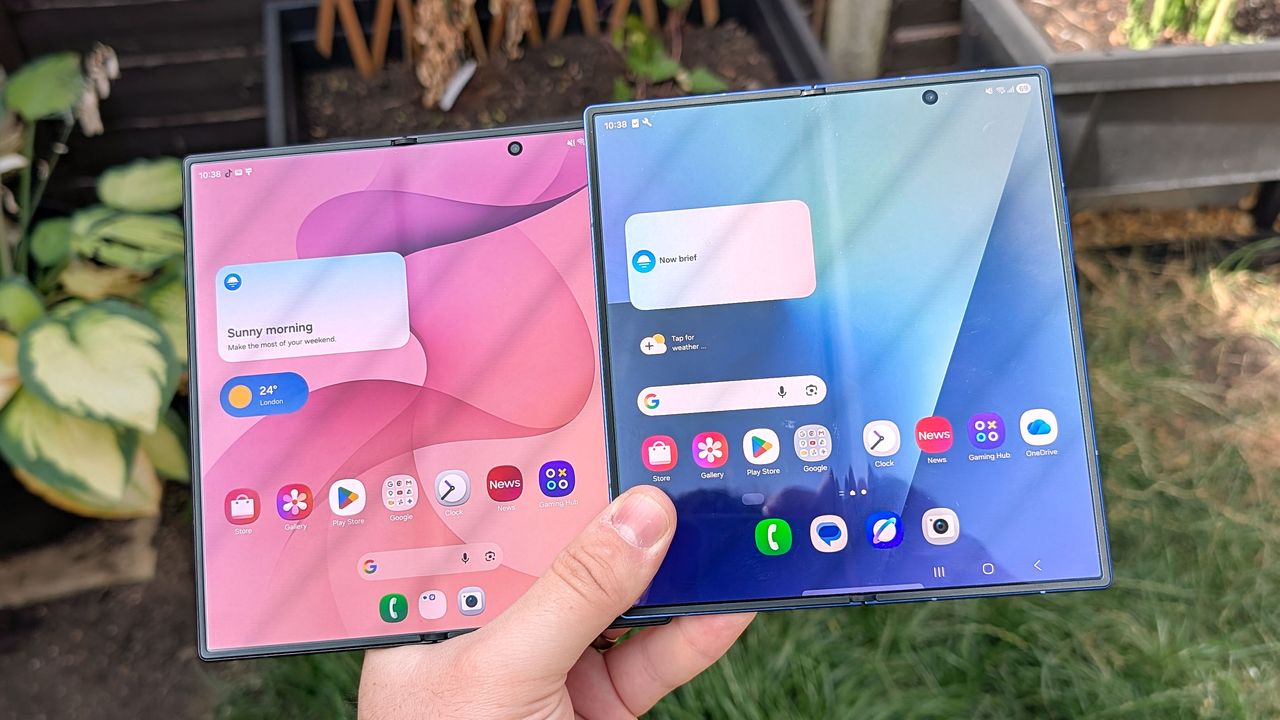
The Samsung Galaxy Z Fold 8 Ultra is now on sale, arriving as the successor to last year's Galaxy Z Fold 7, which is described as a foldable that was already considered excellent when it launched. According to Tom's Guide's comparison, the Z Fold 7 started at $1,999 for a 12GB/256GB model, with 512GB and 1TB versions priced at $2,199 and $2,499. The publication's spec table lists the Z Fold 8 Ultra starting at $2,099, though the accompanying article text instead states pricing begins at $2,199 for 12GB/256GB, rising to $2,299 for 512GB and $2,699 for 1TB with 16GB of RAM — the two figures within the same outlet do not match. A separate Tom's Guide deals roundup states the Galaxy Z Fold 8 Ultra starts at $2,099, while the standard Galaxy Z Fold 8 starts at $1,899.
Design-wise, the Z Fold 8 Ultra keeps roughly the same shape and size as the Z Fold 7, though cases made for the Fold 7 reportedly don't fit the new model. The biggest change is a new Flex Titanium display that significantly reduces the crease down the middle compared to the Fold 7, though it isn't fully eliminated. The Fold 8 Ultra's screen is also notably brighter, hitting a peak of 2,687 nits in testing versus 2,245 nits on the Fold 7, and its new anti-reflective coating cuts down glare and reduces visible reflections in bright conditions.
Under the hood, the Z Fold 8 Ultra uses a custom Snapdragon 8 Elite Gen 5 'for Galaxy' chipset — the same one found in the Galaxy S26 series — while the Z Fold 7 ran a standard Snapdragon 8 Elite chip. Benchmark testing showed the Fold 8 Ultra scoring 3,733/11,457 on Geekbench single/multi-core versus 3,052/9,735 for the Fold 7, along with higher scores in 3DMark's Solar Bay Unlimited test (49.24 fps/12,950 vs. 41.21 fps/10,912) and Geekbench AI (71,715 vs. 59,663).
Camera hardware is largely shared between the two phones, including the same 200MP main sensor, 10MP telephoto lens with 3x optical zoom, and 10MP selfie cameras on each screen. The Fold 8 Ultra's ultrawide camera was upgraded to 50MP from the Fold 7's 12MP. Testing found the Fold 8 Ultra captured more detail from the main lens and performed noticeably better in low light, while ultrawide, selfie, portrait and telephoto shots were described as similar or only subtly different between the two phones — telephoto zoom quality was called poor on both.
Battery life saw a substantial jump: the Fold 8 Ultra's 5,000 mAh silicon carbon battery lasted 14 hours and 33 minutes in a web-surfing battery test, compared to 10 hours and 44 minutes for the Fold 7's 4,400 mAh battery. Charging is also faster on the new model — 45W wired versus 25W, and 20W wireless versus 15W — allowing the Fold 8 Ultra to reach 76% charge in 30 minutes compared to 54% for the Fold 7.
Now that both phones are available, deals are already appearing. Retailers including T-Mobile, AT&T, Verizon, Xfinity Mobile, Best Buy, Samsung and Amazon are offering discounts of up to $1,900 or $1,200 with trade-ins, or flat gift-card and credit offers, on both the Galaxy Z Fold 8 and Galaxy Z Fold 8 Ultra. Tom's Guide's overall verdict is that the Z Fold 7 remains a strong foldable, especially at a discount, but calls the Fold 8 Ultra the better option for anyone buying new, citing improved battery life, performance and display quality as the most impactful upgrades.